How paint matching actually works — and why the code is not enough
Two cars, same paint code, visibly different colour. This is not a mistake; it is how modern finishes behave.
By GROZAH AUTO LAB
Paint codes identify a formula, not a guaranteed outcome. Manufacturers produce colour variants within the same code across plants and production runs, pigment batches differ, and every car then ages under its own sun exposure. A five-year-old red in Los Angeles is not the red that left the factory.
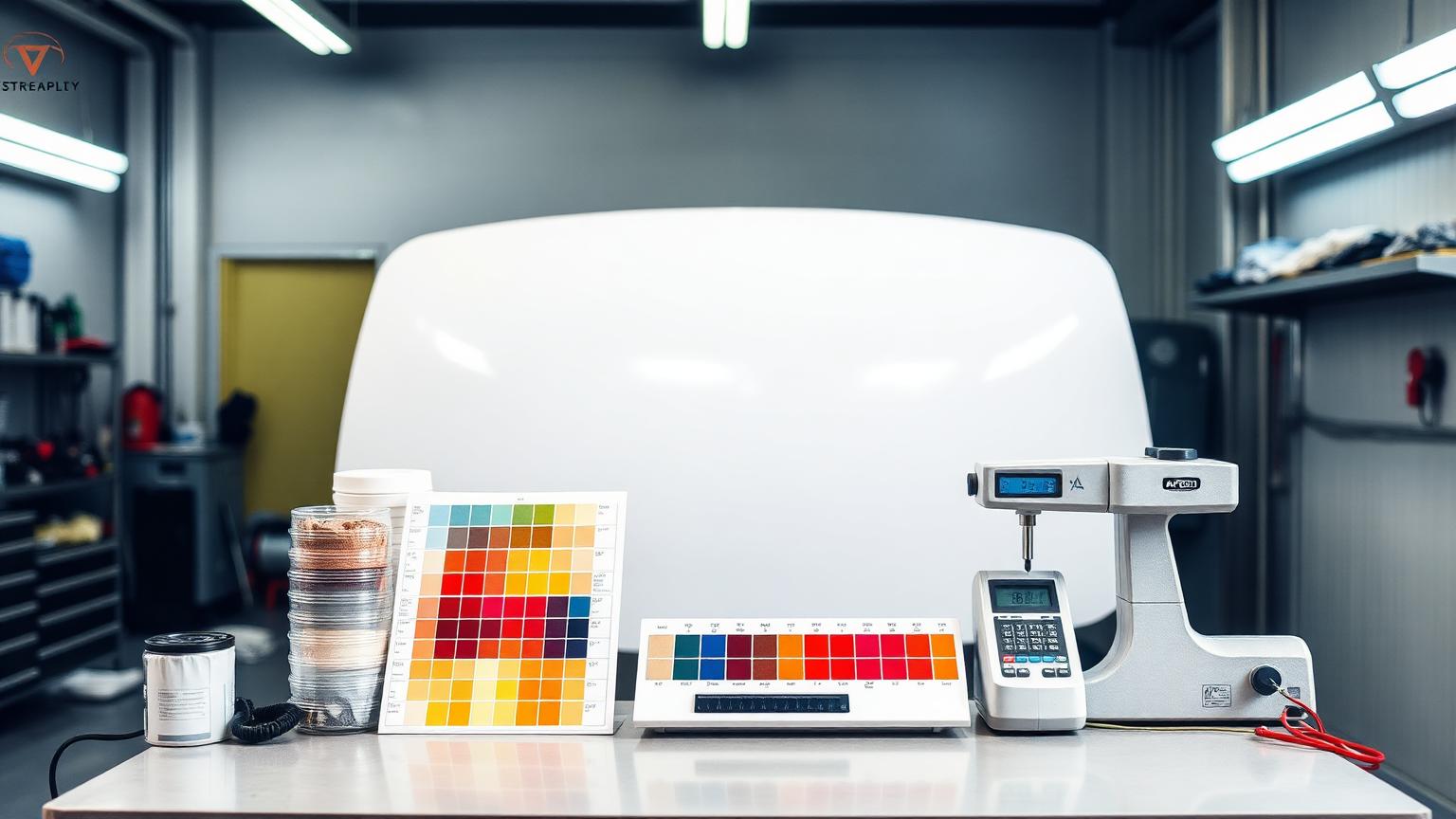
That is why a proper refinish begins with a spray-out card: the mixed colour is sprayed on a test panel, cured, and compared against the actual vehicle under multiple light sources — daylight, shop light, and often a colour-matching lamp. Metallic and pearl finishes add a second dimension, since flake orientation changes the appearance with viewing angle.
Blending is the other half. Rather than painting a single panel to a hard edge, the refinisher fades the new colour into the adjacent panels so any residual difference is distributed across a gradient the eye cannot detect. Blending costs labour and materials, and its absence is the usual reason a repaired door "looks fine" from one angle and wrong from another.
Application technique closes the gap: spray distance, gun setup, number of coats and flash times all affect how metallic flake lies. When someone says a match is invisible, they mean the colour, the flake orientation and the texture of the clear coat all agree — three variables, not one, and none of them is contained in the code.
Where this is handled
GROZAH AUTO LAB
Collision, structural and paint work in Los Angeles — including ADAS recalibration and insurance claims.
Visit AUTO LAB →